Tuesday, 8 March 2011

What works for us...

This is the last part in my "what works" series where I share and review which curriculum works for us. This time I am reviewing our "together" subjects. These are History, Geography, Science, Art and Music Appreciation, and Poetry Memorization. These subjects we do together and this is the part that I really enjoy in our homeschool. It's mostly Adrienne, Andre and myself, but Celeste tags along too sometimes.

First Canadian History:


We are learning about our country's history this year and really loving the curriculum we are using. The Modern History Through Canadian Eyes is a guide to study Canadian History using several resources. I chose to use the Story of Canada, the Spirit of Canada, and Footprints in the Snow. The guide also lists other core resouces. Every unit has a list of world events and people to match that time period, along with Canadian events and people, and additional reading suggestions. I use all this information to get more books from the library as needed. Some units also have suggestions for extra projects (writing, research, field trips or other). These types of guide/curriculum is what I really enjoy working with. It gives me a guideline but allows me to add my own selections as well if I want to. The kids have also said they have enjoyed learning more about their country's history this year.


In World Geography, we are using the Trail Guide to World Geography. This is the second time we are using this guide. The first time was a couple of years ago. Adrienne and I had followed the literature study included in the guide, reading Around the World in 80 Days and making our way through the world with it. This year, we are using the main portion of the guide and studying the geography by mapping, trail blazing, and using the geography trails. The trail blazing is a list of ideas for extra activities to do for each week, each part of the world. The geography trails are like trivia questions. My kids really enjoy doing these (to my surprise!). They search through their own atlases to find the answers. The guide has three levels for the trails. Adrienne and Andre also  have made their own illustrated geography dictionary. They both really like this curriculum and I have enjoyed using it. We use library books, folk tales or even travel videos to supplement. The guide includes so much that I know I will be using it again for several years. I do have the CD that includes all the notebook pages for each level and Uncle Josh's Outline Map book. I had printed and photocopied everything I needed at the beginning of the year which really helped!
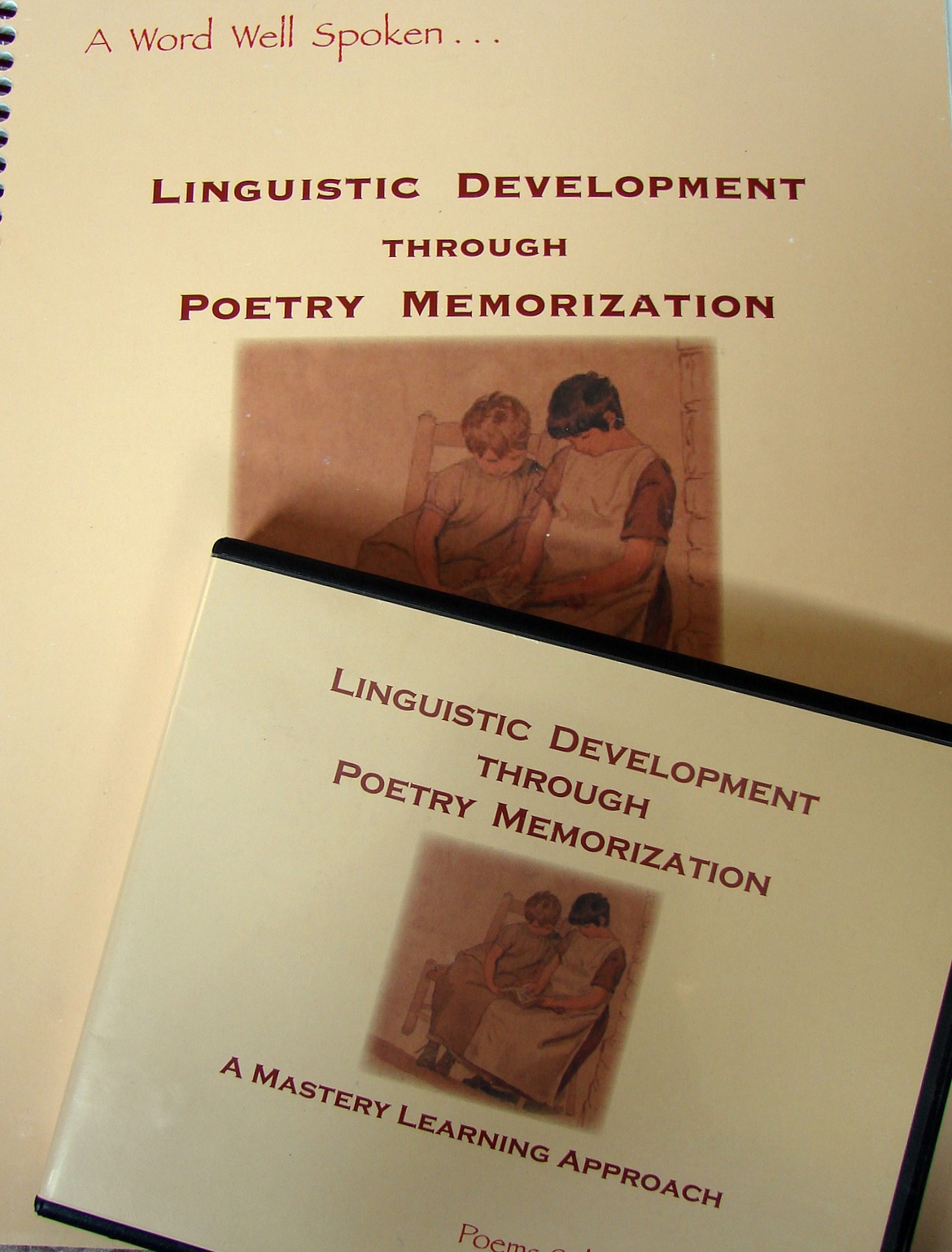


Another subject that my kids have really enjoyed this year is Poetry Memorization. This was something I have always wanted to include in our homeschool, but never really got around to it until I found this curriculum. The Linguistic Development Through Poetry Memorization by the Institute of Excellence in Writing (IEW) is a very easy program to implement. We read the poem, memorize it, and recite it every day. Every week, we add a new one. All three of my children participate in this one. The poems are appealing to all of them. This is another program that will last a few years, as there are four levels of poems in it. We are only working on level one this year.


The Art and Music Appreciation we are doing this year is basic but we enjoy our Friday afternoons discovering painters and musicians. We are using the guide from Harmony Fine Arts, the Logic Stage level 7.  I am using her program as a guideline and searching for the music online (free) or at the library. We then write a short biography and record the names of the music selections we listened to on our notebook pages. For the painters, I also search online or use the links already mentioned in the guide, or the library. We view and talk about the works and record their names and our thoughts, along with a biography of the artist. It's simple but we enjoy it. I am not using all the suggestions in the guide at this point but what we are using, works.


This last subject, Science, also works but partly.

I pulled my own curriculum together this year for science. We chose to study physics, following somewhat the Well Trained Mind rotation. I decided to try the Physics Workshop kit from Thames & Kosmos to add a hands-on part to our study. This kit has over 70 experiments, all related to physics. We are using the Usborne Science Encyclopedia (Internet Linked) as our spine. We have used the suggested internet links a lot and learned from them. We also use notebook pages to record definitions, narrations, drawings and lab notes.

The Thames & Kosmos kit came with an experiment manual which I used as my guideline and is filled with information. I have used it also as a spine for certain topics. The part that my children and I have been disapointed with are the experiments and the workshops. Each experiment is preceded by a workshop where you build the item that you will need for the experiment. I am including a photo below of one of the workshops. You can see there is a little bit of text explaining what you are doing, but no other explanations. We have had to guess a lot of the time by looking closely at the picture. Our science lessons are sometimes frustrating because of this lack of explanations. That is why I said it works partly. Science isn't a subject my son looks forward to because so often we haven't been able to build the experiment properly!


This is the conclusion of my series on what works for our family. I hope you have enjoyed reading my posts, and maybe you will share what works for your family, curriculum wise too. Let me know if you do by leaving a comment.  This series was very helpful for me as well, taking the time to review our choices will help me decide for next year.

If you missed the other posts in this series, here are the links:

What works for Celeste

What works for Andre

What works for Adrienne.

Celeste is six years old, Andre is 12, and Adrienne is 13 years old.

Sunday, 6 March 2011

Book Sharing Monday :: Peter Kent's City Across Time


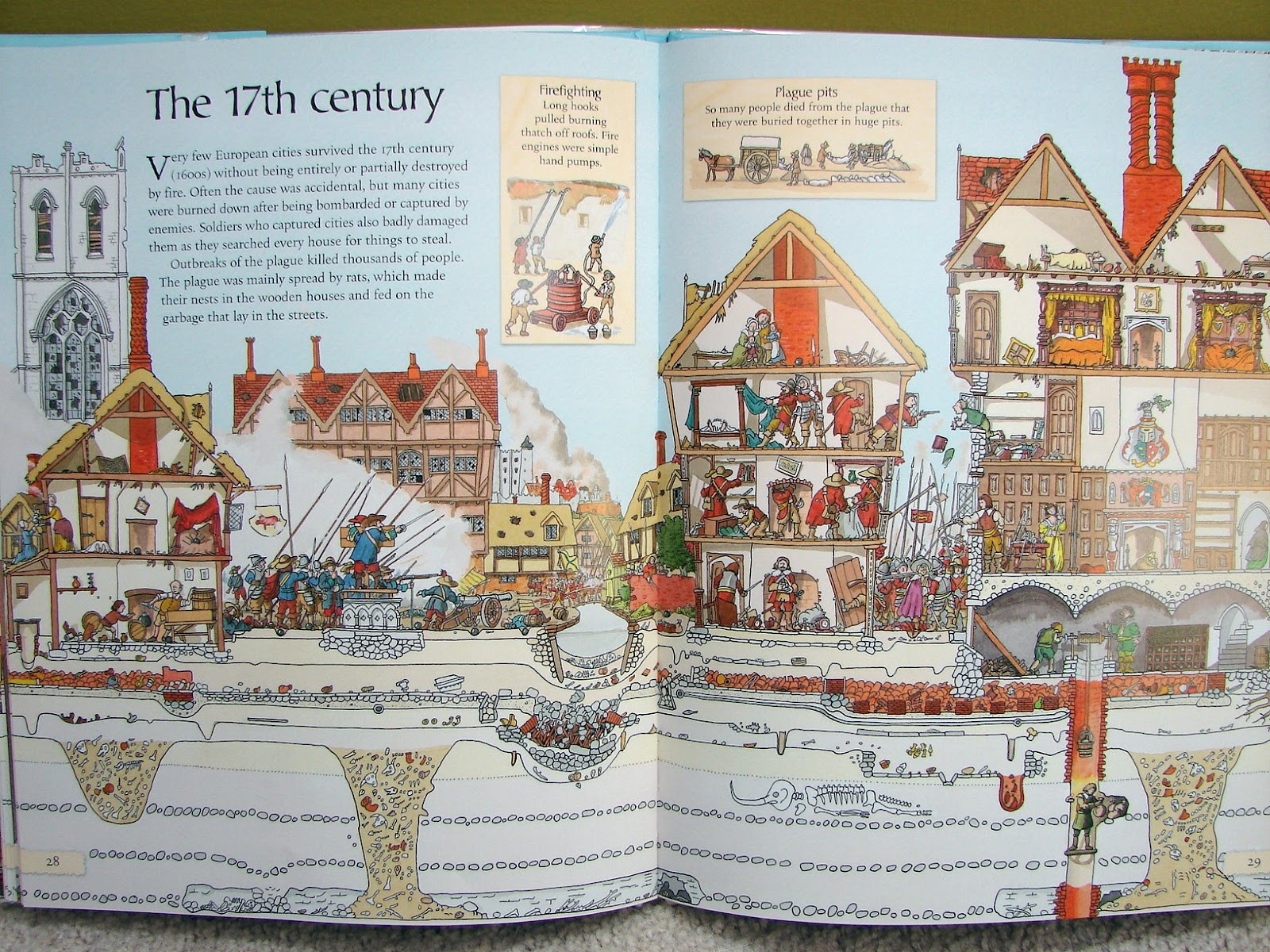
Peter Kent's City Across Time is a great picture book filled with cross sections showcasing an imaginary settlement through the ages, from the Stone Age, through Ancient Roman Times, Middle Ages, all the way to the 21st Century. There are special pages as well on particular topics, like the catacombs, a medieval mine, an underground railway, and secret bunkers. The illustrations attracted us to this book first, but we soon realized that it was very interesting as well. The text is filled with historical and archaelogical information. There is also a "Treasure Trove" page that explains what kind of objects archeologists look for, along with drawings of a few particular pieces that you can look for throughout the book.
This is a great, fun and educational book!


Here are a few sentences from the introduction:

"Many towns and cities in the world are very old. In Rome, Jerusalem, Damascus, London, and other places, people have been living on the same site for thousands of years. Although most of the houses, stores, and offices you see in such ancient cities today are not much more than 100 years old, underneath them lie the remains of the buildings they replaced: layer upon layer of ruins mixed up with broken fragments of household items and garbage. Each century leaves its own layer of remains - like the age rings on a tree - the most ancient buried the farthest down."

If you would like to participate in Book Sharing Monday, include the link to your book sharing post below. Happy reading!

Friday, 4 March 2011

Weekly Wrap-Up ~ World Maths Day, World Spelling Day and the Rest!

This week we participated in the World Maths Day and World Spelling Day. This is a free yearly live online international event that is open to everyone. Each event runs for 48 hours. This was Adrienne and Andre's second year participating in the Math Day, and Celeste and mine's first. Parents, teachers and other adults could sign up too! Each participant is put in their own age category. Celeste was in the 4 to 7 year olds category, Andre and Adrienne in the 11 to 13,  and I was in the 18 and over. Over five million students participated from 218 countries!


My kids really love to see where their competitors are from. They were able to use our computer and a laptop (thanks Nana!) this year and kept trying to get each other (Adrienne and Andre were in the same age group).


Throughout the competition, you are able to see your own statistics in your profile. There are 5 levels of difficulty. You can do as many games as you want, but the first 20 games in each category counted towards your official score. Adrienne and Andre completed 101 games each in the Math, Celeste did 45 and she had the highest accuracy! Each game lasts 60 seconds, so the fastest you are the more answer you can submit. Even though they played the same amount of games, Adrienne answered 2235 questions, while Andre answered 1106.

In the spelling day, the set up is the same. In Celeste's level, she had to select which word was being said instead of spelling it. She really enjoyed this one too!


I also competed in these two events. It was fun testing myself. The level 5 in Math was super challenging without a calculator. Most questions I couldn't do!

There are two other things that my kids really enjoy about this competition: checking out what country the other students are from and creating their own avatars! This year, we had a lot of competitors from the United Kingdom, United States, Pakistan, and Australia.


Now for the rest...

We finished our study of Africa in World Geography. We will take next week to review what we have done so far this year, before moving on to Asia.

In Canadian History, we wrapped up our study of World War I on Monday by visiting this site. We watched World War I From Above, a very interesting documentary. Adrienne and Andre used the different quizzes and games. We also watched the NFB movie Paris 1919. You can see the trailer below:


The rest of the week, we read about the 1920s and 1930s in Canada. We are now at the onset of World War II.

In Science we learned about the different forms of energy. We read the Usborne Science Encyclopedia. Adrienne and Andre wrote definitions in their notebooks. Andre tried to build the rubber band car from the experiment kit but it didn't work out this time.

This afternoon, we learned about Giuseppe Verdi during Music Appreciation. We read his biography on Classics for Kids and listened to different parts from his Aida opera. I read aloud the picture book Aida told by American Soprano Leontyne Price. We then googled her name
and watched some of her performances on youtube. My children agreed that she has an amazing voice, and even though they don't really like opera, they enjoyed listening to her. Below you can see photos of the picture book I read. Aida is a beautiful and powerful story. We also thought this was perfect timing since Aida is an Ethiopian princess and we just finished our Africa study in World Geography.


Friday is also the day when we complete our JN Mystery Class charts, you can see this week's charts photos in this previous post.

We continued with our regular subjects as well, Math and Language Arts. We had missed a few weeks of Poetry Memorization but started again this week. Everyone remembered all the poems studied so far!

That is our week! If you would like to read other weekly wrap-ups, you can visit Weird, Unsocialized Homeschoolers.

Journey North Mystery Class ~ Week Five


The charts showing sunrise and sunset date up to February 28.


Adrienne working on her journal page for Week 5.

Thursday, 3 March 2011

What works for Celeste...

In this third part of my "what works" series, I will be sharing what works and what doesn't for my youngest, Celeste. She is six years old.

We cover Language Arts and Math together while Adrienne and Andre do their independent work in the morning. This seems to work for us so far. Celeste "hangs around" in the afternoon while we do the rest of our subjects, History, Science, Geography, etc... She is picking up things but I don't require her to do any of the work.


What works for us is basically what we are doing.

I am using Explode the Code for phonics, spelling and handwriting. She enjoys working through these workbooks and I can see that she is learning as we go along.

To practice reading, we are using the Elson Readers Primer. We are past the halfway point in this and I can honestly say that we are both enjoying it. I use the teacher's guide to introduce the story to her and the new words, which I write down for her in the notebook. The stories in the teacher's guide match the ones in her reader, but are usually longer and give more details so she is familiar with the main idea when it's her turn to read aloud. We rarely use the worksheets.

For Math, we are using Miquon Math. Celeste really likes doing Math with these workbooks. She uses the manipulatives when she needs them. I haven't brought out flashcards, choosing the discovery approach instead of drilling. I personally don't like the teacher's guide that goes along these workbooks. I don't need it at this point but we will need to switch to a different math curriculum when she gets to higher levels, probably Teaching Textbooks.

I sometimes feel like I am not doing enough with Celeste, but at the same time I can see the benefits of not pushing her. She is enthousiastic about learning new things and gives herself copywork or other school-ish stuff to do, all on her own. 

Even though this isn't curriculum, it works so I wanted to share! She has a basket where she keeps a lot of the books and things that she can go to if we're busy. In this basket, she has sticker books, her game boy and games, some of her favourite books and easy readers, pens and paper, an erasable board...


She also likes to pull out games that she can play by herself. I took a picture of some of her favourites. Rush Hour is a family favourite and she really likes working through this puzzle. FunThinkers is a fun and educational game (with the number tiles on the photo). The other is something to practice math facts with. It's called Sum Time by Jumbo. We also have a spelling one. We were given these, so I am not sure if they are still available.

The next post in this series will cover the subjects we do together.

LinkWithin

Related Posts with Thumbnails

Labels

Fun home learning book sharing monday family books wordless wednesday nature journey north art wrap-up weekly report Reading nature study holidays photography science geography sketch tuesday canada homeschool report Me pets quilting cooking for our earth DPP Movies outdoor challenge sewing exploring get outdoors Fairy outdoor hour Iditarod birthday challenge math summer celeste journey north 2009 100books Dragon Lego music Princess animals halloween home journey north 2010 lapbook NaNoWriMo author fiesta field trip public school wreck this journal poetry 12 secrets baking birds blogs journey north 2011 spring city curriculum fitness gardening moving black history month bugs earth hour journey north 2012 planning reading my library shutter sisters sled dogs this moment travel unschooling December board games calendar quilt lego quest swap air cadets feeding my family food revolution hockey library recipes what works air show author study award backyard bird count camping dr seuss father's day pirates roald dahl space sports what my children are reading year 5 Ballet DQS6 St Patrick's Day TED talks arnosky basketball biographies eating clean for others geocaching happiness mail medical memory monday orion poems science rendezvous scree-free week 2011 skating spelling winter solstice winterfest youtube 2010 olympics Charlottetown PEI Patricia Polacco Rant appreciation book collecting good deeds helping others hooping hunger games jamie oliver maze nat orchestra peace quilt-along screen-free week snail stamps the next chapter book club video games wilderness wednesday wish wednesday world news writing